Calculadora De Factor Comun . El factor común es el primer producto. Puedes hacer factorización con la calculadora de factorizar siguiendo estos sencillos pasos: funcion logaritmica GeoGebra from www.geogebra.org Calculadora de factorizacion que permite factorizar una expresión algebraica online, los pasos de cálculo son detallados. Share a link to this widget: Calculadora de factor común monomio resuelve tus problemas de matemáticas con nuestra calculadora de factor común monomio paso a paso.
Limiting Reactant Calculator Moles. Mole number of hydrogen= (4g hydrogen/ molar atomic mass of hydrogen) to consume 1.5 mole of oxygen, (2×1.5)=3 moles of hydrogen will be required. First, to calculate the mass.
2 moles of hcl are produced and 1 mole of cl 2 stays. 2na (s) + cl 2 (g) → 2na cl (s). Mol of s = mol of.
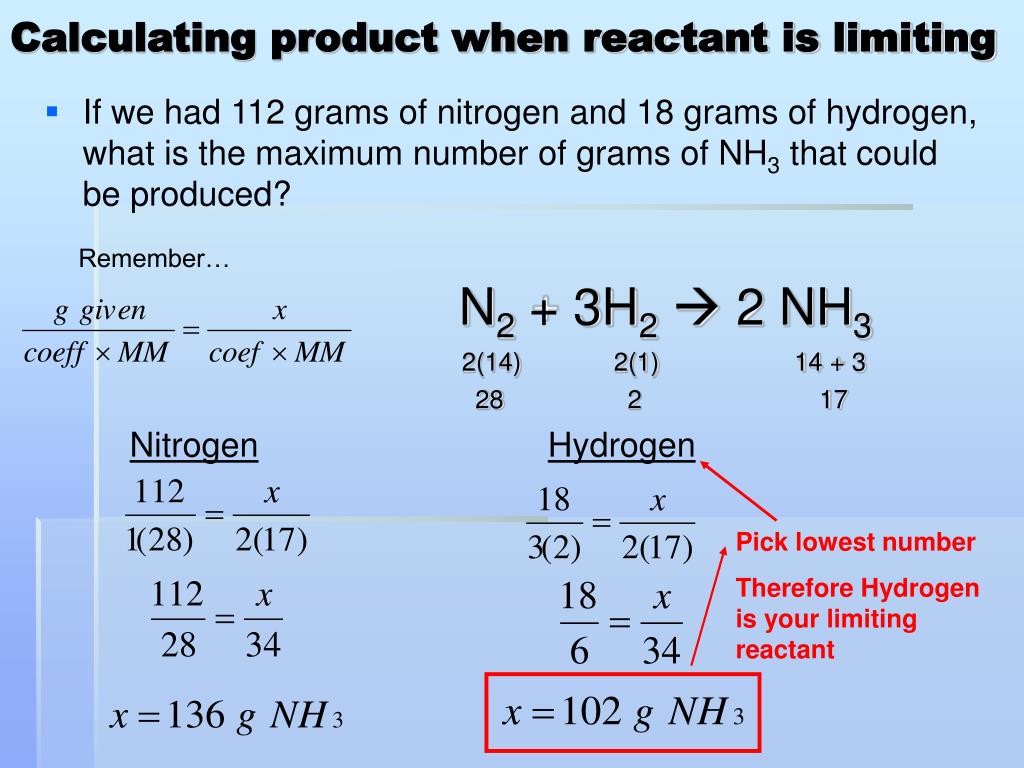
Causey Shows You How To Find The Limiting Reactant (Reagent) And The Maximum Product From A Chemical Equation Using Stoichiometry.
To calculate the mass of titanium metal that can obtain, multiply the number of moles of titanium by the molar mass of titanium (47.867 g/mol): 2 moles of hcl are produced and 1 mole of cl 2 stays. Divide the number of moles of each by the coefficient in the.
Cl 2 Is The Limiting Reactant & H 2 Is The Excess Reactant.
1 mol s produces 1 mol fes. In most limiting reactant stoichiometry problems, the real. Pick a reactant and calculate how much product you can make assuming excess of the other reactant (s).
# 15 Calculate How Many Moles Of The Limiting Reactant Reacted In The Reaction.
The above information can also. This online chemical reaction calculator checks whether a given chemical equation is balanced and finds the appropriate stoichiometric coefficients. It is the limiting reactant.
There Are Only 0.25 Moles Of Hcl (Instead Of 0.3 Moles), So The Hcl Will Run Out First.
Enter answer with at least four significant digits. While on the other hand, h2 forms approximately 270.045g. Limiting reactant is a chemical reactant which limits the quantity of formed product.
Cu + O2 + Co2 + H2O = Cu2 (Oh)2Co3.
0.07880moles i2 ⋅ 2amoles k 1mole i2 = 0.1576 moles k. The limiting reactant is that whose value is smallest after dividing the mole number by their coefficient: 2h2 + o2 = 2h2o.


Comments
Post a Comment